Choose Peace Over Competition
- Anna-Karina Schmitt
- Jan 7
- 8 min read

Updated: Jan 24
In sport, for life.

No matter what you aspire to, there will always
be someone who is better than you.
This is not the problem. This is reality.
The mistake is believing that competition is about beating others.
True competition is about being present with all you got in each moment. It is about doing what you can with what you have, right now. Some days that means winning. Some days it means learning. Both are necessary.
Healthy competition only exists when it is directed inward.
I have spoken with many elite athletes across different sport disciplines.
Those who remain grounded, fulfilled, mentally and physically healthy and consistent — regardless of results — all share the same attitude: They compete with themselves. They respect others without fearing them.
That principle does not belong to sport alone. It belongs to life. It is compassion.
From Sport to Life
In yoga philosophy, there are a few simple principles that help describe this way of living and competing — guiding you to look inward, walk your own path, and stop seeing others as a threat. They come from the Yoga Sutras of Patanjali, where the Yamas and Niyamas are described as ethical guidelines for life. Two that resonate strongly with this blog are:
Ahimsa — non-violence. In modern terms, this means not harming others, but also not harming yourself through constant comparison, pressure, or self-criticism. And then there is
Vairagya — detachment. This is the ability to fully commit, give your best, and at the same time let go of the result. You show up, you do the work, and you release the need to control what happens next.
Together, these principles describe healthy competition:
show up with integrity,
respect others without fear,
stay present with what is, and
let go of outcomes you cannot control.

📖 For a simple and accessible introduction to these ideas, my reading recommendation is The Yamas & Niyamas by Deborah Adele. Originally published in English; translations are available in several languages depending on the retailer. Amazon link.
Fear Is Not a Strategy
In recent seasons, I experienced situations that revealed how deeply fear can touch something as beautiful as freediving. Different female athletes reached out to me which disciplines I would enter, which competitions I would attend, and they signalled, they would adjusted their plans based on my presence, based on my performance. Similar situations happened the years before. On one hand, this curiosity might be natural. On the other, I found it surprisingly offensive. Mentally, it affected me more than I expected and created pressure that was completely unnecessary.

On the surface, this may look strategic. In reality, it is fear camouflaged as control: fear of someone else winning. Fear of not being enough. And fear always creates pressure where none is needed. This pressure doesn’t make you better — it makes you smaller, and it’s contagious to other athletes and to the sport in general.
The Illusion of Loss
Let’s be honest about what “losing” really means. The worst possible outcome is not someone else standing higher than you. The worst outcome is abandoning your own integrity, joy, and health.
If two people give their best — fully, safely, and honestly — and arrive at the same result, that is not a loss. That is shared dedication. A shared love.
If someone goes further than you, that is not an attack. That is information. You can choose to be inspired, to train harder, or to accept that your priorities lie elsewhere. All of these choices are valid.
What is never helpful is resentment.
A Record Is Easy. Peace Is Not.
If you choose to target records, I am not being judgemental here, it is completely valid, there is always a way in freediving. Go for it with a clear mind and full focus, without constantly looking to your left or right.
What’s important to remember is this: a record is never something we own forever. And that is a good thing. Records are temporary by nature. They are moments in time, not identities.

I sometimes observe how tightly people hold onto records — watching others closely, comparing attempts, measuring themselves against who holds what. In my experience, this creates tension rather than growth.
Every athlete puts in effort. For some, things may come more easily; for others, the path is steeper. That difference is natural and inevitable.
It does not make an achievement less earned — and it is not ours to judge. Respect for the work, the process, and the courage it takes to show up matters far more than the number attached to a result.
There Is Room for All of Us
In freediving — still such a young sport — there is an incredible amount of space to explore: different disciplines, new depths, distances, and times. Freediving makes this especially visible, but the lesson applies far beyond the water. There is room for different disciplines. Room for different talents. Room for different timelines.
No one’s path takes space away from another.
The same is true in careers, relationships, creativity, and personal growth. The success of another does not reduce your potential — unless you decide that it does. The sense of not enough comes from mindset, not from other people surrrounding you.
The Subtle Side of Exposure
Some other challenges are quieter, more subtle — yet they carry the same weight.
Last year, after sharing publicly that I had won the Swiss championship, a fellow freediver and person I consider a friend commented on my post questioning my eligibility:“Congratulations Anna-Karina! Out of curiosity, how can you be Swiss champion if you are not Swiss?” Instead of reaching out privately or checking the facts with the organizer (AIDA), she chose to make it public.
At that moment, I was already navigating a very difficult season: chronic ankle inflammation, adapting my training on land, a last-minute discipline change, and heavy emotional responsibilities in my private life. My grandmother was moving, two family members had passed away, and the administrative and emotional weight of closing entire lifetimes largely fell on my mother and me. My grandmother’s changing moods and aggression were especially painful, given that she had raised me and was once my closest person.
I received that comment while standing alone in the kitchen of one of those apartments, the day after the competition, exhausted from driving there straight from the final day.
For a brief moment, it made me question everything — even whether I was “allowed” to succeed, despite following all official rules.
With time and distance, I’ve been able to let it go. I no longer see the comment as personal, but as something that amplified what was already present — pressure, insecurity, or tension around competition. The same applies to quieter challenges I’ve faced: people talking behind my back in a shared community, even those I had supported or invited to train with. What stayed with me most was disappointment, that the energy I offered wasn’t always reflected back.

My learning has been to let emotions move through me instead of letting them settle inside. Through meditation and energy work, I’ve learned to release what gets blocked by disappointment and guide it back into focus, love, and peace — in life and on competition day.
I’m deeply grateful to Manou Meier, manoumaier.ch, who supported me in releasing stuck energy and finding my way back to peace and focus during one of my weakest moments last year.
These experiences remind me why focusing inward is essential. It’s not always other people that test you — sometimes it’s the environment, the unspoken culture, and how you choose to meet it within yourself. Feelings like fear, frustration, or disappointment are not wrong; they are information. If you’re willing to listen, they can lead you back to clarity.
When insecurity appears, I return to my core values: health and my love for freediving. Like any practice, this requires consistency — not perfection. You don’t do it once and move on; you do it every time it’s needed, and it gets easier.
If you feel like your energy is else where, its mostly up to us to make a change. My advise: take your power back! Choose your response — and don’t let momentary turbulence define you or your direction.
What True Strength Looks Like
On the other side of the coin, I share records, knowledge, and training spaces with other athletes, many of whom I consider good friends. We support each other without needing to know everything. We respect boundaries while still choosing generosity over jealousy. This is strength. In sport. In life.






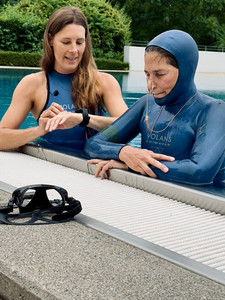
Visiting Tenerife in December meeting friends, I noticed the same supportive spirit among several German male athletes. To me, this is how sport should work.
Another positive example: Recently, a friend shared her goal of breaking a beautiful record in 2026. The response from others around her in that round and me was pure joy and encouragement. We are all athletes, and we cheer for each other. Way to go!
What I have learned so far, there are many successful people who build themselves in peace. I choose to watch out for those. There will always be others and that is ok too.
A Lesson Beyond Sport
You don’t need to be a person in sport to understand this. If you are an entrepreneur, an artist, a parent, a student, or simply someone trying to live well — the principle remains the same:
When you live in rivalry, the first price you pay is your own peace. When you live in comparison, stress enters quietly. When jealousy takes root, growth slows.
But when you focus on alignment — on your values, your effort, your path — energy returns. Health improves. Joy becomes accessible again. Love and respect are not naive. They are efficient. Your path will unfold quietly. You will walk it effortlessness.

Train Your Mind So Your Potential Can Flow
Visualization with clear intention — neutralizing negativity and gently releasing stuck energy — has supported me deeply, both in life and in competition.
I work with athletes and people whose performance matter to overcome nervousness, fear, and insecurity, allowing their potential to unfold naturally. The approach combines calming the nervous system and teaching the body to choose peace as a default state, with guided visualizations tailored to your specific performance — from freediving and sport to speaking, singing, or important professional moments. If you’re curious to learn more or feel this could support your own path, feel free to reach out.
What I Choose
I choose to support my friends, my students, and the people I mentor. I choose safety, clarity, and responsibility in my environment. I choose to remain open, even after experiencing negativity. I refuse to play games driven by fear. Because love is the opposite of hate.
Remember This
What matters is why you do what you do. What matters is how you show up when no one is watching. What matters is whether you can look at yourself with respect. Keep growing. Keep choosing integrity over comparison. Keep doing the work — calmly, honestly, and with your heart. That is true competition.
Writing this blog felt a bit like a confession and therapy. Sharing these thoughts has helped me growing and overcoming blockage and I hope it can spark reflection for you too.
I would love to hear from you: How do you experience competition, comparison, or rivalry — in sport, work, or life? What helps you stay grounded, focused, and at peace when pressures arise?
Let’s start a conversation about competing with peace, choosing presence over fear, and supporting each other along the way.
Further Reading & Inspiration on the Topic
Jesper Stechmann: Mindset and Competition in Freediving — How letting go and enjoying freediving helped this world champion succeed.
Your Competition is Not with Others – A thoughtful take on focusing on your own journey instead of comparing yourself to others.
Competition Not Comparison – How shifting your competition inward removes jealousy and turns rivalry into joy and motivation.


Comments