Freediving and the Media
- Anna-Karina Schmitt
- Jan 24
- 10 min read

Yesterday, on our last flight back home to Switzerland from Dominica, the man sitting next to us was watching the documentary One Breath with Alessia. As I glanced at his screen, I felt something deep irritating inside me. I realized that I had written this blog article a long time ago—but never published it. And suddenly, it felt like the right moment.
This article is about how freediving is often perceived as an extremely dangerous sport, closely associated with blackouts and even death. I get asked these questions all the time: Have you ever blacked out? Isn’t that crazy? Aren’t you afraid? Some people are even openly negative about freediving, without really knowing what it is.
I want to be very clear about one thing from the beginning: I personally really like Alessia and have a lot of respect of her success and her freediving. I met her while competing at a world championship, spoke with her, and I truly feel—and know—that she is a good person, guided by her heart and her deep love for freediving. From what I can see today, she is also not taking the same level of risks in her diving anymore. The many blackouts shown in the film feel, to me, like part of a very personal journey toward a specific record. And that, in my opinion, is something anyone could go for with the right amount of safety divers, its just not what freediving is.
What is not okay is that this becomes the image of the entire sport. Freediving is not about blackout after blackout. That is not what it is all about. This distinction is very clear to me—and to all my freediver friends—but not to someone who is hearing about freediving for the very first time. In all our training dives since 8 years we had no severe incidents like that.
Sitting there on the plane, I had to stop myself from interrupting the man next to me just to say: Freediving is not this. It is a sport of inner peace, connection, and love for the ocean. But I stayed quiet. So instead, I chose to finally publish a blog article that had been sitting in my draft archive for a long time, sharing my personal experiences with freediving and the media.
When media seeks drama instead of reality
In 2024, after finishing work on a documentary, the team began planning its release and related media features. During that process, they came across footage of my 2021 dive at the World Championships — a 75-meter national record attempt that ended with a blackout because of an accident. In one of our video calls, I was asked whether they could use this footage for a television show with the highest ratings of a sports channel in Germany. I immediately refused.
Instead, I encouraged them to put their effort into something more meaningful: to accompany me in my training, to document the preparation and mindset that lead up to competitions and to world record dives. I invited them to show what freediving truly is — not a snapshot of an accident from years ago, but the journey, the growth, and the discipline behind every dive. Outdated footage showing a brief accident would have painted a completely wrong picture — both of the sport and of myself.
Two reasons why I said no
There were two main reasons why I declined the request. First, I don’t want freediving to be represented through accidents. Accidents can happen in any sport — yet somehow, when it comes to freediving, the media loves to focus on blackouts, records, danger, and drama. But that’s not what our sport is (usually) about.
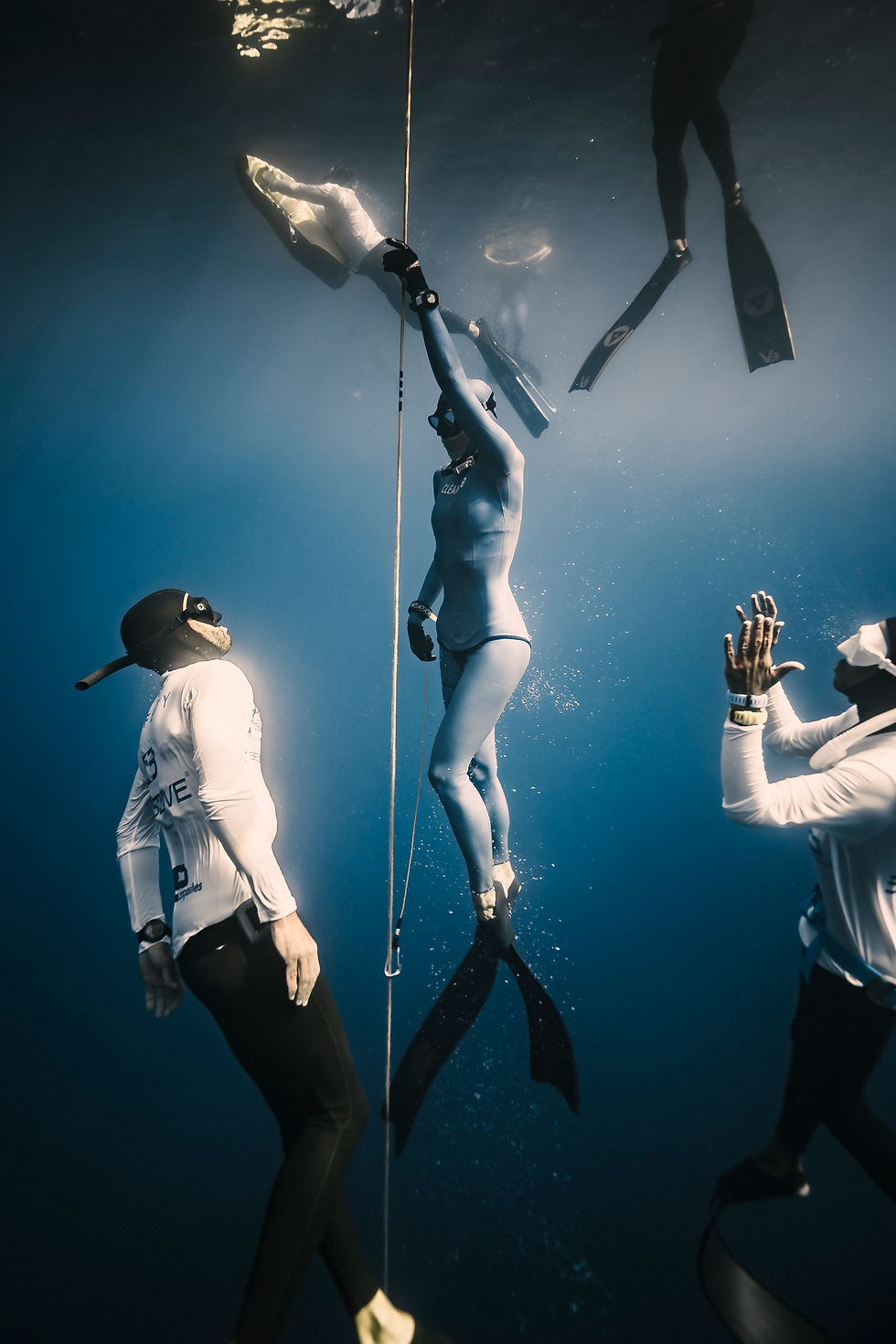
Freediving is not just
an extreme sport
It’s a practice of awareness, patience, and self-control. We train to slow the heartbeat, to relax the body, to quiet the mind. We dive not to fight against nature, but to move with it. Showing a blackout might make for a dramatic clip, but it tells nothing about the calm, the discipline, or the depth — both physical and mental — that freediving requires.
Second, that video no longer represents who I am as an athlete or a human today. My entire approach to diving has evolved — my technique, training, and mindset had all grown in ways that made that old footage from 2021 feel like a completely different version of me. Freediving is about progression. Every season, every dive changes you. To show a clip from years ago, taken out of context, would have been like showing a chapter I’ve long outgrown.
The accident comes with a lesson
That dive in 2021 is one I still remember vividly. It was a 75-meter national record attempt at the World Championships. I remember I only had the absolute minimum—two minutes—for my breath-up before the dive, which already added some extra stress. The area around the competition rope was insanely crowded. Athletes were coming and going non-stop, like in a factory hall at full production mode—except instead of machines, it was freedivers trying to turn inwards.
Not exactly the calm, zen atmosphere you’d hope for before diving a personal best performance and a national record… ahaha.
What I learned from that experience is that this is simply part of competing—and it’s up to the athlete to be prepared not only the performance itself, but for the surrounding stress too.
The real work is turning inward, reconnecting with your inner light and the values that brought you to this sport in the first place. It’s not about the medal. It’s about inner peace, freedom, and being fully present—the state of mind that carries you through the dive, no matter what is happening around you.
Nevertheless, I reached the target depth cleanly and began my ascent — calm, focused, and confident. Then, unexpectedly, my lanyard tangled around the line three times in a row.
In that moment, I managed to stay focused. I resolved the tangling, continued upward. Short after the lanyard was free again, as I continued my ascend, I kept my eyes fixed on the rope, focusing on staying aware and awake, on the sensations in my legs, kicking up, on keeping calm. I knew the Diveye was watching, and that everyone was alert and ready to assist in case of a blackout. That awareness actually helped me a lot — if this had to happen somewhere, I was grateful it happened in one of the safest possible environments, during a World Championship.
Even though I wasn’t completely sure I could make it back up on my own — and of course, that thought added to the anxiety and stress and oxygen consumption as a result— I also knew I was surrounded by a strong safety team, by friends I trusted. That gave me the confidence to keep going. I was deeply motivated to finish the dive. I didn’t want to give up.
However, in the first few seconds after surfacing, while reaching for my mask, I forgot to properly execute my recovery breathing. Recovery breathing is something we practice preventively to ensure that, in case of low oxygen after surfacing, we do not lose consciousness. On this dive, with all the excitement of untangling, I reached the surface right at the edge. Because I didn’t focus enough on the correct breathing technique, I briefly lost consciousness for a second or two.
When I opened my eyes and realized I hadn’t received a white or even a yellow card — yellow because I had lost the tag during the dive — I was devastated. I had fought so hard to stay present through every challenge of that dive, knowing that the extra stress from getting tangled would increase my oxygen consumption.
Yet, despite everything, the story ended in a way that didn’t reflect the effort, focus, or growth behind it. Looking back, that experience taught me a valuable lesson. Just three days earlier, during training, I had noticed a small issue with that same lanyard — a minor tangle that I dismissed as a one-time occurrence. It had never happened before, so I assumed it would never happen again.
The lesson is clear: if something fails once — even slightly — address it immediately. Equipment can always be replaced. Safety, confidence, and peace of mind cannot.
What Freediving is
From the outside, people see someone doing records diving deeper than most people imagine human are capable to, on a single breath and think it’s all about courage or adrenaline. But it’s actually the opposite. Freediving is about staying completely calm, even on what might feel like the most exciting day of your life. Unlike most other sports, where energy and speed drive performance, here you slow your heart rate, relax your muscles, and quiet your thoughts. Everything softens until there is only presence — a clear awareness that connects you to the water.

Each dive is a dialogue between the physical body, the unconscious, the conscious mind and the environment of surrounding water. Learning to hold that conversation takes years.
Freediving is a lifetime-practise
It demands a patient and gentle preparation. It’s not a sport that can be rushed. It unfolds slowly — through hours of training and practice, reflection, and adaptation. Many skills we use under the surface must first be built and deeply integrated on land.
On a physical level, freediving combines endurance, strength, and equalization. We train our bodies to use oxygen economically — to deliver it precisely to the muscles that need it and to conserve it everywhere else. We condition ourselves to tolerate high levels of carbon dioxide and to stay relaxed even when the urge to breathe arises. The heart learns to slow down. The blood redistributes itself to protect vital organs. The body becomes more intelligent in the way it uses energy.
Then there is equalization — the art of balancing internal and external pressure as we descend. It sounds simple, but it’s one of the most technically challenging aspects of the sport. To equalize efficiently at depth requires fine motor control, awareness, and years of dedicated practice. Some freedivers spend two, three, or even five years mastering just this one skill before they can safely dive beyond 40 or 50 meters.
And beyond the physical, freediving is profoundly mental. Every deep dive is a mirror of the mind. The water amplifies whatever we bring with us — tension, fear, or calm. To perform well, we must learn to shift from the stress-driven “fight or flight” mode into a state of deep relaxation.
This becomes especially clear at the deepest point of the dive — the turn. When we reach our target depth and begin the ascent, it’s often the most mentally intense moment. The body is under maximum pressure, and the mind knows there’s still a long way back to the surface. If thoughts of fear or doubt arise — What if I can’t make it? What if something goes wrong? — these thoughts immediately trigger the release of stress hormones like cortisol and adrenaline. These hormones accelerate the heart rate, increase muscle tension, and cause the body to consume oxygen faster. That’s exactly what we need to avoid.
Freediving is a perfect example of how the mental directly shapes the physical. The calmer we are, the slower our metabolism. The more peaceful our thoughts, the more efficiently our body uses oxygen. So we train not only to move gracefully through the water but also to stay calm when darkness, depth, or silence awakens inner fears.
We learn to face these thoughts — not to fight them, but to transform them. Sometimes we can reframe them into positive focus; other times, we simply neutralize them.
One of the greatest teachings of freediving is learning to reprogram yourself — to stay calm, centered, and fully present, even when the world around you turns dark and cold, and your body is under extreme pressure.
Beyond the water, the lessons of freediving carry into every area of life. Whether at work, in family life, or when confronting personal challenges, the mental clarity and resilience developed through freediving become tools that help to navigate difficult moments with confidence.
On a practical level in my own life, freediving has taught me patience, planning, and the value of steady, consistent effort. I didn’t just learn these lessons — I live them. Every day, in my training and in my daily life, I experience small moments of progress, learning to trust the process and follow each step with intention. Freediving has shown me that we can achieve anything we set our minds to if we are clear about our goals, understand exactly what steps are needed to reach them, and have the patience to follow the process. Anything truly meaningful or ambitious won’t happen in a week. All that have become tools I carry into work, family, and personal challenges. Freediving hasn’t just shaped how I dive — it has shaped how I live, every single day.
What I Wish the Media Would Show (More Often)
I’m not ashamed of my accident — it was part of my journey, and it taught me invaluable lessons. In fact, I’m grateful it happened when it did. But I don’t want the story of freediving to be reduced to moments like that — not on Netflix, not in any other format. I want people to understand it for what it truly is: a sport of intelligence, community, awareness, and connection,
We don’t dive to escape life; we dive to feel it more deeply. We don’t hold our breath to fight nature; we hold it to become part of it.
Yes, accidents can happen — but they are rare, and they’re not what defines freediving. The essence of this sport lies in patience, discipline, and self-awareness. It’s about learning how to stay calm when the pressure rises, how to trust the process, and how to find presence even in the most demanding conditions. What often gets lost in media portrayals is that these moments of calm and control are not just underwater — they’re a reflection of what we cultivate every day through training and intention. Freediving teaches us to bring that same clarity, focus, and peace into every part of our lives.
We can’t — and shouldn’t — ignore that freediving carries risks. Every dive requires preparation, teamwork, and respect for safety. But when we reduce it only to its dangers, we erase the deeper story: the discipline, awareness, and quiet transformation it creates.
Freediving is not about escaping life or flirting with danger. It’s about entering life more fully — one breath, one moment, one dive at a time. That’s the story worth telling.


Comments