How Depth Actually Happens
- Anna-Karina Schmitt
- Feb 1
- 11 min read

Updated: Feb 2

After returning from Dominica one week ago — full of energy, trust, and a deep sense that I’m on the right path.
For myself. For what I’m building.
And for what’s coming in 2026: a business rooted in authenticity, self-responsibility, and sustainable performance — not just in freediving, but in life. Dominica reminded me why I do this work.
Arrival: When the Body Sets the Pace
I arrived on the island on January 1st — and I couldn’t walk.
My foot was heavily swollen from the plane, still healing from an intensive surgery in September. The sudden temperature change had triggered inflammation, and the first week I spent mostly sitting, observing, and accepting.
This is not a complaint — it’s simply how it was.
I joined friends for sunsets, relaxed fundive swims along the stunning reef and its breathtaking drop-offs, shared meals, and morning coffee and protein bowls at Nourish, Arron’s new vegan spot at Blue Elements. I savored every moment of what I could do on this pristine island.


We stayed at Soufrière Guesthouse at first — quiet jungle, far from village noise. A place that allowed my nervous system to soften.
Some days I hoped for improvement.
But even without it, I felt deeply grateful to be there.
Healing as a Full-Time Job
Over time, I found a rhythm that worked. Breathing. Meditation.Gentle mobility and stretching. Ice baths at the freediving community gym to calm my foot.

From around 4 pm onward, my foot needed elevation and cooling. Earlier in the day, I could walk a little. One morning, a French man staying at the guesthouse found me sitting quietly on the terrace. Without many words, he gently mobilized my foot and told me something that stayed with me:
“Your foot needs rest. This is a full-time job.”
We talked about life. His son, a freediver who sails and repairs boats. About Greece. About choosing a life that doesn’t slowly kill you. A small, human moment — but a powerful one.
Returning to the Water — with a lot of Honestly
My first session in the water was about reconnecting. I chose to focus on CNF (Constant Weight No Fins), a discipline where the diver descends and ascends using only their body, without fins or a rope, relying purely on swimming technique and freefalling. I wanted to add more meters and continue with CNF from where I left the previous season.
I completed a 50-meter CNF dive split into two parts: one dive down CNF and back up pulling up the rope (FIM). Followed by a second dive the other way around to feel complete. The dive time was long — even for me unusually long — partly because of the saltwater buoyancy I’m not used to, but also because I allowed myself to slow down and listen when part of my body was inflamed heavily.
Being back in the water felt deeply grounding.
No other activity connects me to my breath and inner focus the way freediving does.
It felt empowering to be back in the sea but at the same time something was off. When I looked at it honestly, CNF with an inflamed foot that doesent let me walk at the beach, simply didn’t support healing.
Too much effort, too much energy directed into the legs — even if the foot wasn’t significantly worse afterward, it was clear this path wouldn’t serve progress or recovery.
That honesty became the turning point.
Choosing What Works
I made a decision I had been avoiding for a long time: I switched to FIM.
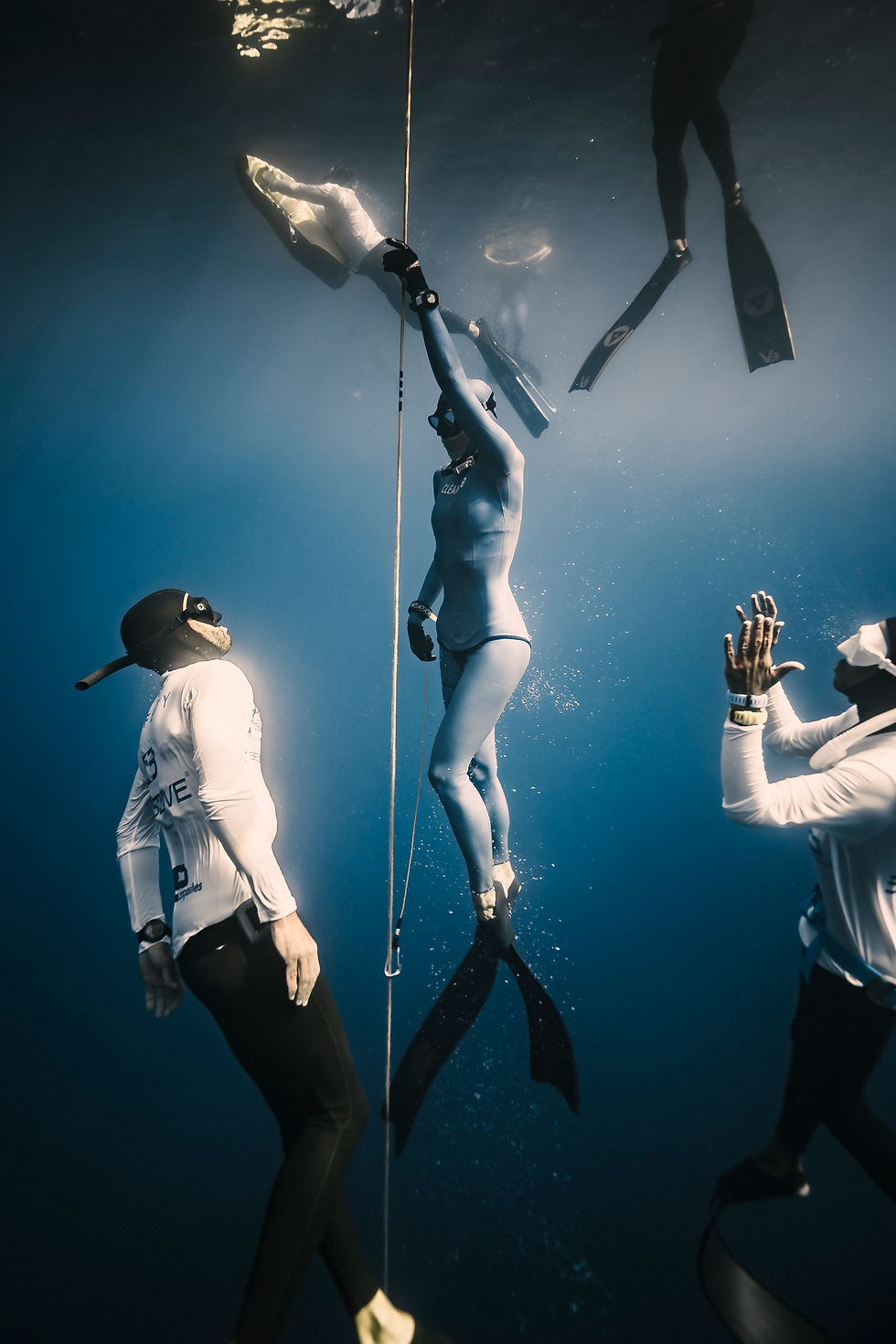
For those who are not familiar with freediving disciplines: FIM (Free Immersion) means the diver pulls themselves down and back up along the rope, staying in constant contact with it. The legs are barely used, which reduces physical load and allows the diver to focus almost entirely on relaxation and equalization.
For years, this option had been on the table. My previous trainer suggested it, friends did and even I knew, that it could support my diving at times my feet is recovering.
Still, I resisted. My only real experience with FIM had been during competitions in Switzerland, where I did it out of necessity rather than choice. I once had a challenging training dive in Lake Zurich at 50 meters, and that experience stayed with me.
Over time, I became deeply accustomed to the relaxation patterns of fin disciplines — bifins and monofin — where my upper body could completely soften while the legs did the work. In FIM, that pattern didn’t translate. I carried tension in my belly, struggled to let go in the right places, and the slower movement confused my nervous system.
My autopilot, trained over years of fin diving, kept sending alarm signals: you’re going too slow.
That pattern also developed, because in the lake Zurich, with no visibility, training with heavier bottom weights, increases safety risks, so we tend to do more trainings with very light bottom weight, that makes FIM very uncomfortable.
And yet, there was a contradiction I couldn’t ignore.
The FIM dives I did complete successfully — especially during the Swiss freediving championships — always ended the same way: with a deep sense of enjoyment and calm once I surfaced. Despite the discomfort I felt in training, something about FIM had always worked beneath the resistance, if it really “had to” work.
This time, listening to my body and respecting the healing process, FIM became the obvious choice.
It allowed me to relax without stressing my foot, to equalize cleanly, and to stay present rather than force performance.

For the first time, I wasn’t doing FIM because I had to — I was doing it because it supported where I was, physically and mentally.
And that changed everything.
Six Sessions. One Clear Goal.
With six sessions left, I wanted to purely sustain that new focus.
The internal goal I set for myself (even though I did not share this goal with anyone at that point) was clear from the beginning: 80 meters.
A big jump — around 30 meters above my previous PB with FIM — but I trusted my preparation.
This was not about chasing depth.
It was about knowing the process that gets me there. Knowing my own potential.
The Method Behind the Meters
1. Goal Setting
The goal was set early. Calmly. Without attachment. I wanted to do 80, but if I would end up at 75, that would still be a good outcome, I told myself. I just wanted to do what I can do and set myself free from pressure.
2. Trial & Error — With Awareness
Every session became a feedback loop.
Nothing was random, and nothing was rushed. With only a handful of sessions available, I couldn’t afford unconscious repetition. Every dive, every sensation, every subtle signal was observed, reflected on, and consciously integrated into the next session.
Before allowing myself to go deep, I focused on quality first. I came into the water to test, if the programming on land worked.
The actual training startet 2 days before my first FIM attempt dive to 60 meters. That was when the seed was born. It started with try EQ drills, rehearsals, meditations and gentle Yoga.
The first training day in the water followed with EQ-specific drills, testing if I can transfer the try skill into depth. The priority was to keep all the air, refine tongue positioning, stay relaxed during charges, and maintain a sealed glottis — especially under increasing pressure. Only when these elements work consistently did I permit myself to set the rope to 60 meters in my first FIM training session. A 10 meter PB.
Depth was never the goal by itself. Depth was the result of sustained focus — across all relevant phases of the dive, from descent to ascent.
In the following sessions we set the rope progressively from session to session: Starting with 60 → 65 → 70 → 75 → 77 → 80 meters, spread across six remaining water sessions.
I assumed — correctly (how it turned out) — that I needed this time to integrate each step if I wanted to reach 80 meters in a stable and relaxed way. There was a special moment at 75 meters. When I reached 75 meters, I intentionally stopped making five-meter jumps. That dive didn’t feel dramatically wrong, but it wasn’t clean either.
During the dive, a boat passed somewhere around, and the extremely loud engine triggered tension in my belly and chest. Equalization became challenging (because of the tension that literally pulled at the glottis, this is exactly why relaxation is so important with deep equalization, we need our chest and belly to be soft, so that the pressure can gently hug us without pulling the glottis) — my glottis involuntarily opened, producing that familiar noise (freedivers will know what I mean). At the same time, I couldn’t stop it and regain full control. I lost air and although I reached the bottom, it was by sheer luck.
It was a clear signal: a moment to slow down. And yet, even if this had been my last dive, I was already very close to my goal and could be at peace with it.
Still, I also knew something else to be true: One less relaxed dive is never an indicator that the next attempt will be the same.
So I consciously detached from that negative assumption and returned to positive reinforcement — a practice I use after every training session and a core part of my overall training strategy. That shift alone changed the quality of what followed.
That experience became productive.
The distraction wasn’t the boat — it was my reaction to it. I needed to refine my ability to stay fully in the zone, regardless of external noise. Just like on my 51-meter CNF dive in freshwater, where the rope was swinging wildly and yet my mind stayed calm and focused — that mental state already existed within me. I simply needed to reconnect with it. So: thank you, noisy boat. And thank you to myself for reading the signs instead of ignoring them.
Obstacles are rarely the real problem. How we respond to them is — and that is something we can influence 100%.
I knew I had homework to do if I wanted to reach a stable 80 meters. Between sessions, I worked almost obsessively on land.

Empty-lung equalization work.
Highly targeted stretches.
Water-pipe EQ drills.
Mental rehearsal focused specifically on improving dive time.
My initial dive time at depth was loooong — around 2:32 minutes for a 60 meter dive — which felt beautiful, relaxed, and present, but also made it clear that this approach wouldn’t scale to 80 meters.
To get closer to one meter per second I required changes.
I adjusted my pulling technique until around 35 meters, added 0.5 kg of weight, and analysed dive profiles carefully. With my foot limiting what I could do on land, all my energy went into improving what I could control.
Testing and improving is where real growth happens — not in how many dives you do, but in how consciously you learn from each one.
3. Mental Preparation — Training the Autopilot
Depth happens first in the mind.
Before every dive, I worked intentionally with my mental setup — to neutralize distractions and create clarity.
identifying and dissolving limiting thoughts
rehearsing each dive mentally, step by step
visualizing equalization, speed, transitions, and surfacing
programming the subconscious so the body could operate on autopilot

When I am attached to the main line before the dive, the work is already done
4. Nervous System Regulation — Calm by Default
Deep diving requires a nervous system that defaults to calm, not stress.
My focus was on shifting into a parasympathetic state — not only before dives, but throughout the days building up to my main performance.
daily meditation practices
slow breathing patterns to lower heart rate
The more regulated the system became, the more stable the dives felt.
5. Respecting Rest — Progress Happens Between Dives
Rest is not a break from training — it is training. With limited fitness state, well I did not do a proper pool training since one year, and zero endurance I knew I couldn’t dive more than two days in a row, without losing focus and energy.
no more than two consecutive water days
reflection and analysis after each session
creating distance from depth to stay mentally fresh
Less water time, more presence. When I returned to the water, I was hungry — not tired.
Reflecting on this brings me back to Davide Carrera’s training philosophy: “The ocean is not a gym — we need to make love to the ocean. I like to interact with the ocean like I interact with a person, the ocean has a soul, is alive, I can feel it, it can feel me, it's not a machine or just molecules of water, it's something more, and swimming and diving to me is sharing love”
I deeply share this approach. I prefer to do my toughest, most demanding work outside of open water — in the gym, on the mat, walking with empty lungs holding my breath, or in the pool. What I choose as a location depends on my surroundings, my life situation, and my current goal.
When I enter the open water, I want presence, curiosity, and respect — not force.
The 80-Meter Dive — Autopilot in Action
Alarms were adjusted to the new depth, and the rope was set. The triggerfish at the platform was peaceful that day, and the team kept a careful watch of me.

I was ready. The actual dive unfolded on autopilot. I was calm, surrounded by a world-class team. I knew exactly what to do to navigate a depth that was both familiar — from CWT and CWTB dives, and from visualizing — and entirely new at the same time.
A “boring” dive is a good dive. Everything went according to plan.
My presence in the moment felt beautiful, even though the dive time was still too long. But compared to the six deep sessions leading up to it, this was by far the most controlled, satisfying, and the one with the best relative dive time. Dive time is something I will continue to refine over a longer timeline in this discipline — some adjustments simply can’t happen in six sessions.
What mattered most was that every single improvement made a significant difference, and my little experiment — going from a 50 meter FIM PB to 80 meters in just six sessions — actually worked. The progress and success weren’t just measurable in meters; they were measured in control, awareness, confidence — and in surfacing with fresh lips.
The Team

This was never a solo achievement. Freediving may look like an individual sport, but the truth is: depth is only possible when safety, trust, and calm energy come first.
I owe so much to my safety angels: Charli Rose Stuart, Kathleen Greubel, Markus Ziegler, David Mellor, Arron Walker, and Allie Reilly. They were present at every session, ready to step in at a moment’s notice, observing, supporting, and ensuring I could focus fully on my dives.
There was one particularly challenging day when deep safety coverage was limited. Max, Aaron, and Kathleen immediately stepped in to provide a countdown and safety, on their way back from a swimming technique training session. Their calm presence allowed me to dive without fear into the unknown — and to reach my goal with confidence.
What This Experience Taught Me (Again)
Again — because this wasn’t the first time, that limited access to water mirrored in clean executed performances. I’ve experienced it before in seasons with very few dives and a 100% success rate, from freshwater CNF dives to moments in my competition history where focus and mental clarity mattered more than volume of water sessions.
If I can reach 80 meters with little water time and an inflamed foot, any advanced freediver can progress safely and sustainably — with the right guidance.

And that’s exactly why I’m hosting a very special freediving camp in May, teaching what lies close to my heart. Where all the magic happens.
What’s Coming Next
In the coming days, I’ll share the schedule for an advanced freediving camp from 23th - 31th of May 2026 in Tenerife, limited to 4 divers only.
It’s for those who want to:
dive calmer
stop turning early
apply strategies for competitive freediving
stop blaming and reinforce improvement
work with their nervous system — not against it
Stay tuned.
Depth is optional.
Predictable performance is not.



Comments